
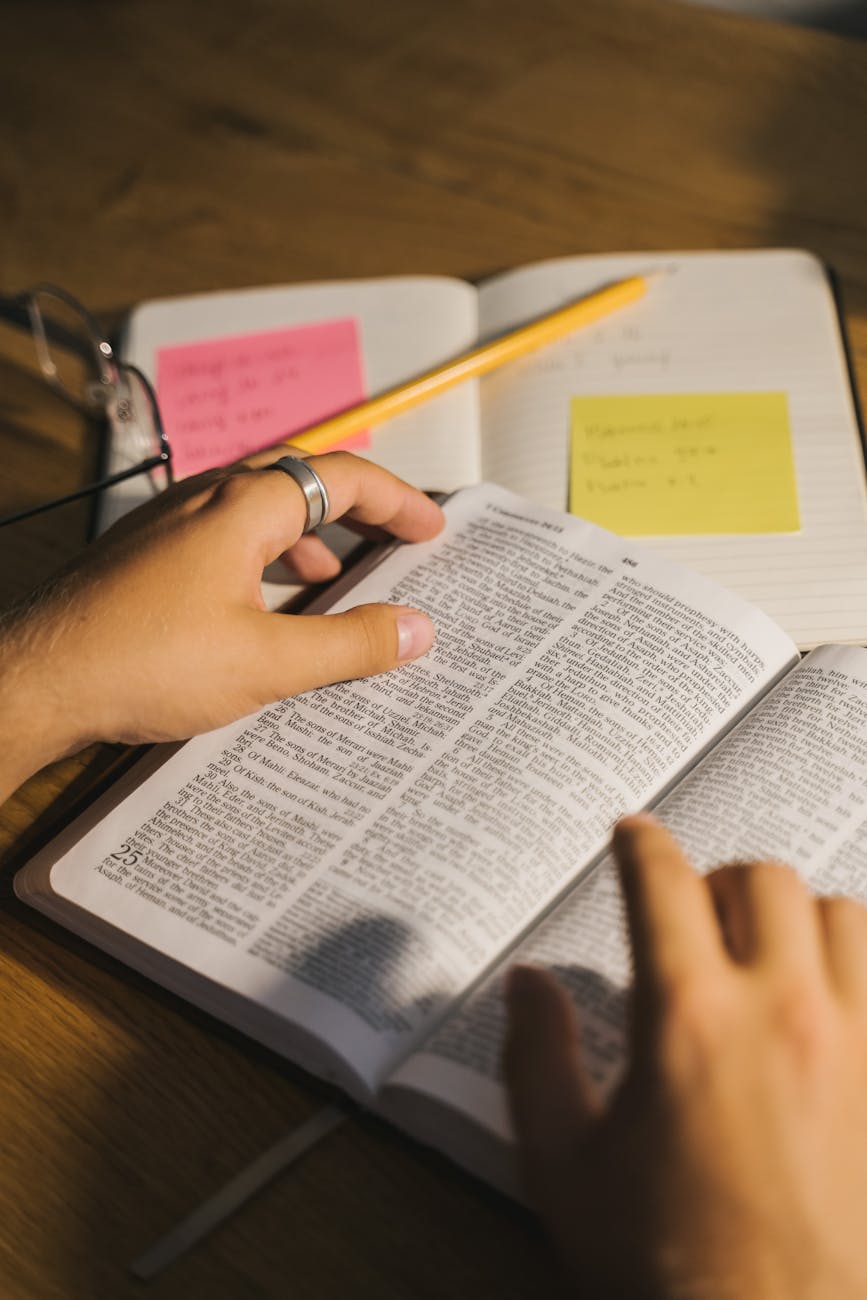
A Physical Bible
God’s Word is God’s Word whether it’s printed, read, sung, or digitized. A physical copy of God’s Word is not more holy than a digital one. But reading a printed copy is not the same as reading a digital copy. I can’t prove this, but there is a connection you make with a physical Bible after reading it over and over again that is not made with a digital copy. For me, there’s something about spending time with God in my physical Bible that is more personal and intimate than when I’m reading God’s Word on a screen. With my physical Bible, it’s like me and God are alone. But on a screen, it’s like I’m aware that people are eavesdropping or knocking on the door wanting me to leave.
The study tools I use below are mostly digital. They’re great. But I can’t bring myself to replace my physical Bible as my main intake time. Maybe others can, but I can’t.
ESV Study Bible
The English Standard Version is a good version of Scripture. It’s not quite as much of a word-for-word translation as the NASB, but is much more word-for-word than the NIV. I’ve used it nearly my entire ministry thus far as my primary Bible for reading, preaching, and teaching. There have been a few times when I haven’t agreed with a translation choice for a specific word, but that’s to be expected.
The ESV Study Bible is very, very good. It compiles notes from 95 Bible scholars and teachers from various backgrounds and denominations. I use it every week.
I pay for a subscription on their website to access it, which includes a lot of other really good resources, including original languages, the Archaeological Study Bible, and the Expositional Study Bible, among others.
BibleGateway.COm
Bible Gateway is free. I mainly use it for copying the text to Microsoft One Note, where I compile all my notes for sermons. But I also use it for checking other translations, cross references, and repetitions of words (a key in narratives).
One downside of this website is the ads. But I’ve been using it so long now that going to the site is in my muscle memory.
BibleHub.com
Bible Hub is another free website, but this one I use for its features in greek. It gives a good lexical summary, word studies, and helps me find every use of every word in Scripture. It looks a little outdated and clunky, but it works, so me gusta.
Commentaries
For me, commentaries are best used to either confirm, correct, or clarify my understanding of Scripture. It’s important for me to let the text itself form my understanding of it, not what someone says about the text. When I want to purchase a printed commentary, I go to bestcommentaries.com to find some (usually 3).
One thing about using commentaries is that I don’t read the whole thing. I’ve never read through an entire commentary. Instead, I just read the portions related to the text I’m studying.
ChatGPT
This one may be a bit controversial, but that’s okay. I’ve started using ChatGPT for one purpose in my study: to build a spreadsheet comparing all the differences between translations of Scripture. It is very, very helpful and saves me a good amount of time.
Here’s something you can tell our controversial AI friend to do to help compare translation differences: “Create a table comparing the word variations in the ESV, NIV, NASB, and NKJV translations of Psalm 23.”
That prompt results in this:
Psalm 23 Translation Comparison (Paraphrased)
| Verse / Element | ESV | NIV | NASB | NKJV |
|---|---|---|---|---|
| 1 — Opening line | “The LORD is my shepherd” (classic phrasing) | same basic phrasing | same basic phrasing | same basic phrasing |
| 1 — Provision | “I shall not want” | “I lack nothing” | “I will not be in need” | “I shall not want” (traditional) |
| 2 — Green pastures | “He makes me lie down” | “He makes me lie down” | “He lets me lie down” | “He makes me to lie down” |
| 2 — Still waters | “still waters” | “quiet waters” | “quiet waters” | “still waters” |
| 3 — Restoration | “He restores my soul” (traditional) | “He refreshes my soul” | “He restores my soul” | “He restores my soul” |
| 3 — Guidance | “paths of righteousness” | “right paths” | “paths of righteousness” | “paths of righteousness” |
| 4 — Valley | “valley of the shadow of death” retained | “darkest valley” | “valley of the shadow of death” | “valley of the shadow of death” (traditional) |
| 4 — Fear | “I will fear no evil” | similar phrasing | similar phrasing | similar phrasing |
| 4 — Comfort | “your rod and your staff” | same | same | same |
| 5 — Table | “You prepare a table before me” | similar | similar | similar (traditional phrasing) |
| 5 — Anointing | “You anoint my head with oil” | same | “You have anointed…” (slightly more formal) | same |
| 5 — Cup | “my cup overflows” | same | “my cup overflows” | “my cup runs over” (traditional variant) |
| 6 — Goodness & Mercy | “goodness and mercy” | “goodness and love” | “goodness and faithfulness” (variant based on hesed) | “goodness and mercy” |
| 6 — Dwelling | “I shall dwell…” | “I will dwell…” | “I will dwell…” or “live” depending on edition | “I will dwell…” |
| 6 — Length of dwelling | “forever” | “forever” | “for length of days” (more literal) | “forever” |
So cool!
I hope some of these tools are helpful for anyone wanting to study God’s Word!


 Pastor Jacob’s Blog