
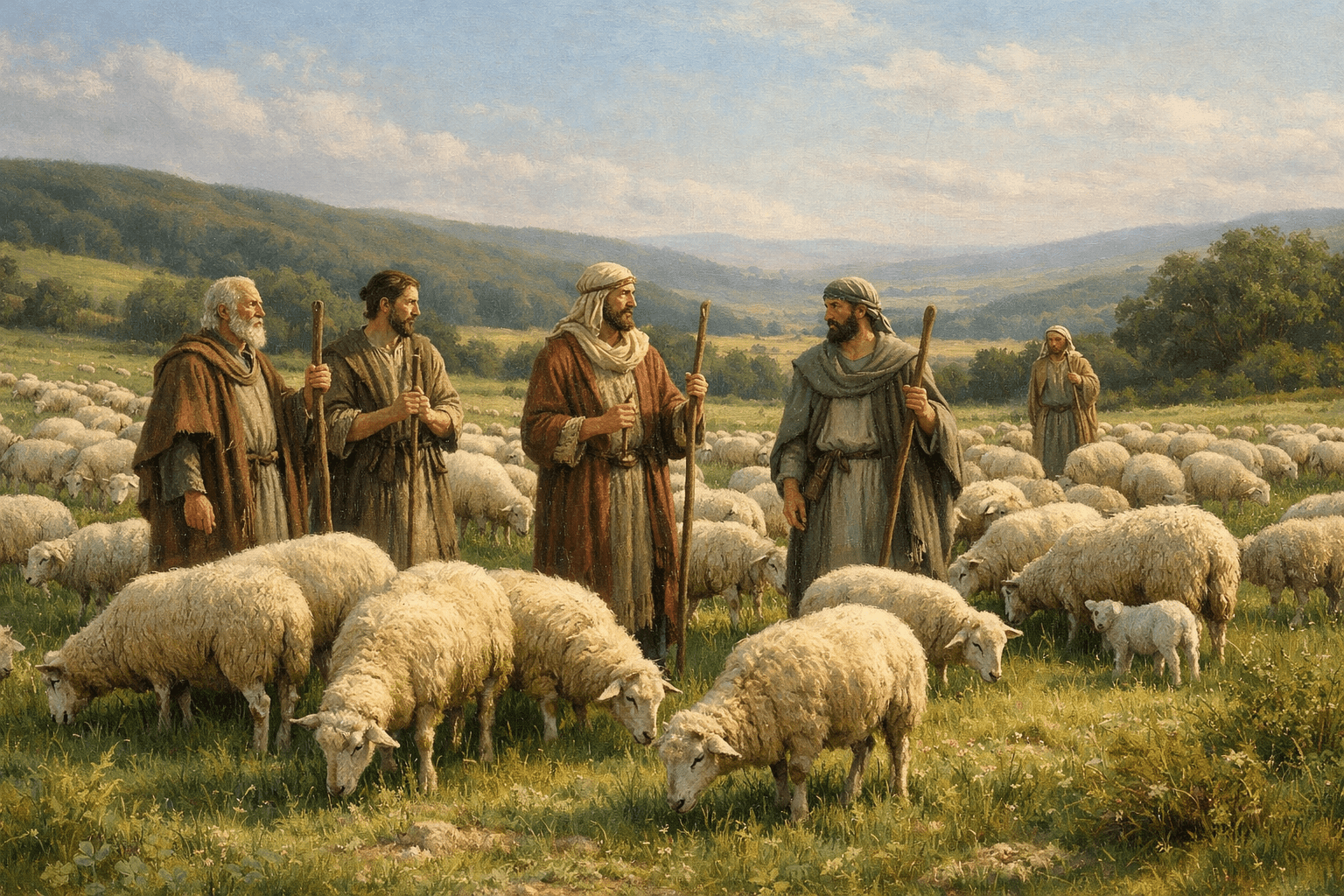
As we get very close to all of the church at Lake Hills looking at the first draft of proposed changes to our church constitution regarding pastor/elders and deacons, I wanted to share a little bit from my final project. Some might say that having multiple elders (or shared pastoral oversight as I often call it) is not required by the New Testament. If it’s not mandated by the New Testament, why should we still do it as a church?
There are lots of reasons why. One that I don’t discuss below is that plural eldership is patterned in the New Testament. Another reason is the one I share below. I find it the most compelling. May this be helpful to any who read.
Shared pastoral oversight over one group of Christians in a certain location by a group of men called pastors/elders/overseers has strong biblical support. After looking at the evidence, it is easy to say that plural eldership was the regular practice of local churches in the NT. But is it required in each local church today?
Some say no. Jeff Brown, retired missionary and adjunct professor at Central Baptist Seminary in Minnesota, said, “It is important to notice that there are examples in the Scripture which give the local church direction, but there are no commands about one or multiple elders.” Millard Erickson agrees with Brown when he says, “There is no prescriptive exposition of what the government of the church is to be like . . . The churches are not commanded to adopt a particular form of church order.” Erickson would go on to say that when it comes to polity, “We cannot discover an authoritative pattern.”
Both Brown and Erickson are correct in that there is no command for adopting a certain polity. But just because something is not commanded does not mean it is optional. For example, while there is no express command for each Christian to be recognized members of local churches, there are so many passages that command Christians to do certain things for specific Christians that it is essentially impossible to be a faithful Christian without belonging to a local church in an official capacity (whether it’s called “membership” or not).
The ultimate question Brown and Erickson are not considering in their claims is this: can Christians do all they’re called to do in Scripture without being under shared pastoral oversight? The answer to that question is “no.” Christians cannot “call the elders of the church” in dire sickness (James 5:14) if the church they belong to doesn’t have plural eldership. Christians cannot obey the leaders who are keeping watch over their souls (Hebrews 13:17) if they don’t have multiple leaders. Christians cannot give “double honor” to the elders that labor in preaching and teaching if those who do so are not part of a group of elders (1 Timothy 5:17). In order for Christians to live as God’s Word says they should, they need to have more than one elder-pastor keeping watch over them.
John Hammett commented on what my project sought to communicate and what it seems the Lord may be doing at LHBC. He said,
“On the whole, the weight of the biblical evidence supports plural eldership, and the practical benefits offered by a plurality of elders seem considerable. Thus, churches should move toward a plural elder model with two conditions: (1) that the church have men who meet the qualifications for elder, and (2) that the church be accepting of such a change.”
Lake Hills Baptist Church has accepted clear, biblical teaching wholeheartedly for many years. There is no reason to think she will stop accepting clear teaching when the topic is on shared pastoral oversight.
If you’d like to read my entire project, you can find it at this link.


 Pastor Jacob’s Blog