
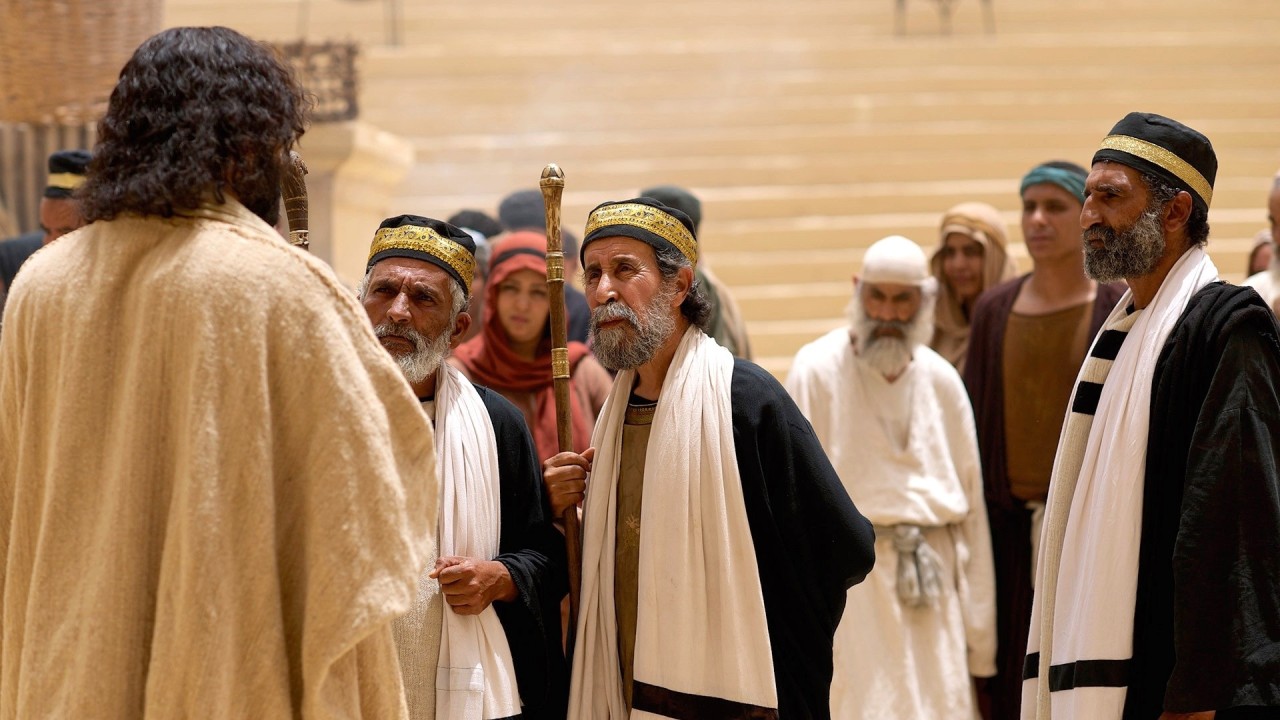
The first four books of the New Testament are called the “gospels,” of course–Matthew, Mark, Luke, and John. They are a genre of writing that’s different than the epistles, prophecy, or poetry, or even historical narrative. Because it’s a unique genre of writing, it should be read with that genre in mind.
It took me until seminary to realize that the gospels are not as straightforward as they appear to be. Each writer didn’t simply write down the events of Jesus’ life in chronological order. Instead, they follow a general pattern of chronology while choosing certain events and interactions to go in certain places in order to make a point. Understanding how and why the author arranges different accounts is a key to good interpretation of this genre.
An Example from Mark 2:1–3:6
Take, for example, Mark 2:1–3:6. In Mark 2:5, Jesus saw the faith of the paralytic and his friends and forgave the paralytic’s sins. Mark points out to us that “some of the scribes were there, questioning in their hearts, ‘Why does this man speak like that? He is blaspheming! Who can forgive sins but God alone?'”
The next account Mark inserts is of Jesus at Levi’s house with many tax collectors and sinners. In that scene, the scribes question Jesus’ disciples in 2:16, “Why does he eat with tax collectors and sinners?” Notice that the scribes have gone from questioning Jesus in their hearts to questioning Jesus’ to His disciples.
Next, we’re taken to another question about fasting. In 2:18, we’re told that people came to question Jesus about His disciples’ lack of fasting. Notice again the progression: first (1) they questioned Him in their hearts, then (2) they questioned His disciples about Jesus, and now (3) they’re questioning Jesus about His disciples.
A fourth question to Jesus comes from the Pharisees in 2:24 as Jesus and His disciples were plucking heads of grain going through the grainfields. Their question intensifies this time even further when they question Jesus about something His disciples are doing. They say, “Look, why are they doing what is not lawful on the Sabbath?” (2:24).
Again, we see a growing frustration with Jesus by the scribes, Jews in general, and Pharisees. The progression goes like this:
- “Some of the scribes” question Jesus in their hearts in 2:7.
- The “scribes of the Pharisees” question Jesus’ disciples about Jesus’ actions in 2:16.
- “People came and said to him,” questioning Jesus Himself why His disciples’ don’t fast (2:18).
- The Pharisees “were saying to him,” indicating an ongoing questioning, about a behavior Jesus’ disciples were doing (2:24).
If this chunk of text were a piece of music, the volume would be getting louder and louder.
Then, in chapter 3, the tension moves to an even greater degree as we’re told that Jesus is in the synagogue with the Pharisees and a man with a withered hand is also there. The Pharisees, who represent those who have been questioning Jesus all along, are watching to see if Jesus will heal on the Sabbath, “so that they might accuse him” (3:2).
Mark has intentionally put all of these accounts together and is now setting us up for a crescendo to the conflict–this time not with the Pharisees questioning Jesus, but seeking to accuse Him.
And what happens next is a little astonishing. Instead of them asking Jesus a question, Jesus asks them a question after intentionally calling the man with the withered hand in front of everyone. He asked the Pharisees, “Is it lawful on the Sabbath to do good or to do harm, to save life or to kill?”
After every question they asked Jesus, Jesus always had an answer that shut them up. But after Jesus asked them this question, Mark specifically points out, “But they were silent” (3:4). Jesus’ response was anger and grief at their hardness of heart.
Indeed, Mark has been showing us that their hearts have been progressively becoming hard over time. What started as an internal question has now resulted in them looking for a chance to accuse Jesus. But instead of them trapping Jesus into an accusation, Jesus intentionally does something that He knew would make them upset right in front of them. After Jesus healed the man with the withered hand, “The Pharisees went out and immediately held counsel with the Herodians against him, how to destroy him” (3:6).
Some suggestions
My purpose in this blog is not to explain and apply all of the nuance from this pericope of Scripture, but to show an example of how to better read and interpret the gospels.
As I come to an end of this post, I offer some suggestions on how to read the gospels better:
- When you’re reading the gospels, continually look for patterns or themes that are repeated in chunks of text. Ask yourself, “Why did the author put this here?”
- In your application of these to your life, focus on these bigger themes that the author is communicating. Outside of these major themes, be careful in overly applying minor details of the narrative. Authors are being led by the Spirit–even gospel writers. But remember that at the same time, they are using their brains to communicate a point.
The truth I have communicated to you today has fundamentally changed how I read the gospel accounts. It has opened them up to become more like a symphony with repeated melodic themes throughout instead of TicTok videos.
I hope this is helpful in your own Bible reading of the gospels.


 Pastor Jacob’s Blog